


Teeth for Life
Teeth for Life | Wisdom Teeth | Sealants | Fluoride | Mouthguards | Whitening | Tooth Restorations | Extractions
Practicing good oral hygiene means maintaining your child’s smile by visiting the dentist regularly and taking care of her teeth and gums in between checkups. Our practice wants to make sure that your child gets the most out of her office visits, and that her teeth stay healthy for life! We’ll work with you to provide complete dental care, and show you how to maintain your child’s smile at home with the right dental products for you and your family.
Dental Cleanings and Regular Checkups
Regular dental checkups are an important part of maintaining good oral health. During regular checkups, the hygienist will:
- Check for any problems that may not be seen or felt
- Look for cavities or any other signs of tooth decay
- Inspect the teeth and gums for gingivitis and signs of periodontal disease
- Provide a thorough teeth cleaning, rinse, and polish
Visiting the dentist every six months gives you and your child the chance to talk with the doctor and receive answers for any questions you may have about your family’s oral health. Checkups are also a great way to find out about new treatments that may benefit your child’s smile.
Choosing the Right Toothpaste and Toothbrush
From toothpaste and mouthwash to toothbrushes and dental floss, it’s important to choose the right products. Keep in mind that when you’re looking for a new toothpaste or toothbrush be sure to choose one that has been approved by the American Dental Association (ADA). Your dentist can also help by recommending certain dental products for use at home.
Learn More
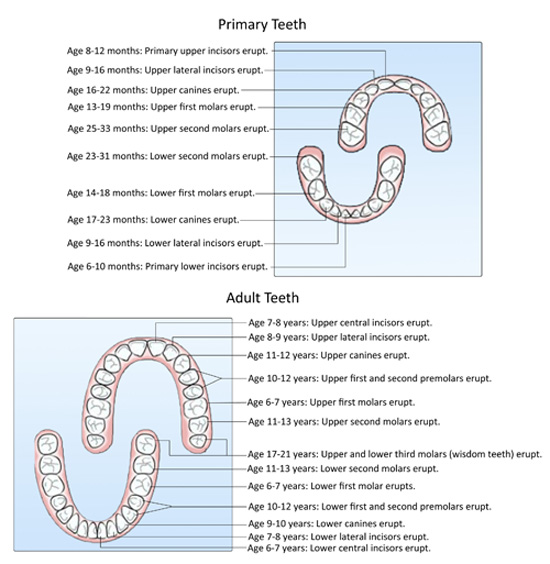
Did you know that at birth, people already have 20 primary (baby) teeth that begin erupting after six months, and that by the time a person is 21 there are no longer primary teeth, and all 32 permanent teeth have erupted?
Getting to know your teeth can be fun and educational!
Click on the links below to learn more facts about your teeth.
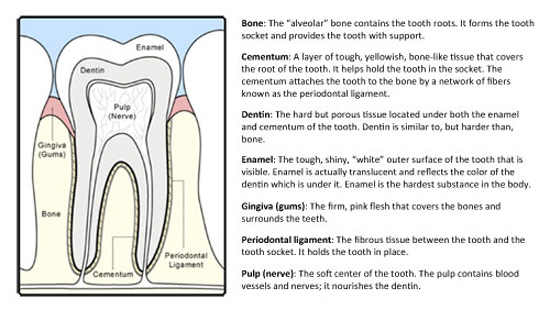
- Anatomy of a Tooth
- Know Your Teeth
-
Age: 6-10 months
Primary lower central incisors erupt.
Age: 8-12 months
Primary upper central incisors erupt.
Age: 9-16 months
Primary upper & lower lateral incisors erupt.
Age: 13-19 months
First molars erupt. The upper molars generally erupt before the lower molars. Average age of shed: 9-11 years.
Age: 16-23 months
Canines erupt. The upper canines generally erupt before the lower canines. Average age of shed: 9-12 years.
Age: 23-33 months
Second molars erupt. Generally the lower molars erupt first, followed by the upper molars. Average age of shed: 10-12 years.
Age: 6-7 years
The primary upper and lower central incisors are shed, and the permanent upper and lower first molars and lower central incisors erupt.
Age: 7-8 years
The primary upper and lower lateral incisors are shed, and the permanent upper central incisors and lower lateral incisors erupt.
Age: 8-9 years
The permanent upper lateral incisors erupt and the primary upper first molars are shed.
Age: 9-10 years
The primary upper and lower canines and the lower first molars are shed, and the permanent lower canines erupt.
Age: 10-12 years
The primary upper and lower 2nd molars are shed, and the permanent upper canines erupt, as well as upper and lower first and second premolars.
Age: 11-13 years
The permanent upper and lower 2nd molars erupt.
Age: 17-21 years
The upper and lower 3rd molars (or wisdom teeth) erupt.
Brushing & Flossing
Preventive dental care is important throughout life, especially at a young age. By practicing good oral hygiene at home and scheduling regular checkups with the dentist, your child can help keep her smile bright and healthy for many years to come. Here are a few simple ways to prevent the build-up of plaque and cavities:
- Make sure your child brushes her teeth at least twice a day with a soft-bristled toothbrush. Use fluoride toothpaste to remove food particles and plaque from the tooth surfaces. Also be sure she brushes the top surface of her tongue; this will remove any extra plaque causing food particles and help keep her breath fresh!
- Make sure your child cleans between her teeth by flossing at least once a day. You can also use a mouthwash to help kill bacteria and freshen her breath. Decay-causing bacteria can linger between teeth where toothbrush bristles can't reach. Floss and mouthwash will help remove plaque and food particles from between the teeth and under the gum line.
- Brushing Instructions
-
-
Brushing: Step 1
Place your toothbrush at a 45 degree angle to your gum.
-
Brushing: Step 2
Brush gently in a circular motion.
-
Brushing: Step 3
Brush the outer, inner, and chewing surfaces of each tooth.
-
Brushing: Step 4
Use the tip of your brush for the inner surface of your front teeth.
-
- Flossing Instructions
-
-
Flossing: Step 1
Wind about 18 inches of floss around your fingers as shown. Most of it should be wrapped around one finger, and as the floss is used, the other finger takes it up.
-
Flossing: Step 2
Use your thumbs and forefingers to guide about one inch of floss between your teeth.
-
Flossing: Step 3
Holding the floss tightly, gently saw the floss between your teeth. Then curve the floss into a C-shape against one tooth and gently slide it beneath your gums.
-
Flossing: Step 4
Slide the floss up and down, repeating for each tooth.
-
Gum Disease
Gum disease (also called periodontal disease) is an infection of the tissues that support your child's teeth. It is a major cause of tooth loss in adults. Because gum disease is usually painless, you may not know your child has it. At each regular checkup Dr. Clark and her hygienist will evaluate your child's gingival health.
Gum disease is caused by plaque, a sticky film of bacteria that constantly forms on the teeth. These bacteria create toxins that can damage the gums.
Periodontal diseases attack just below the gum line in the sulcus, where they cause the attachment of the tooth and supporting tissues to break down. As the tissues are damaged, the sulcus develops into a pocket; generally, the more severe the disease, the greater the depth of the pocket.
Periodontal diseases are classified according to the severity of the disease. The two major stages are gingivitis and periodontitis.
Gingivitis
In the early stage of gum disease, called gingivitis, the gums become red, swollen and bleed easily. At this stage, the disease is still reversible and can usually be eliminated by daily brushing and flossing.
Periodontitis
In the more advanced stages of gum disease, called periodontitis, the gums and bone that support the teeth become seriously damaged. Whereas healthy gums and bone anchor teeth firmly in place, infected gums can cause teeth to become loose, fall out, or have to be removed by a dentist.
Some factors increase the risk of developing periodontal disease:
- Tobacco smoking or chewing
- System-wide diseases such as diabetes
- Some types of medication such as steroids, some types of anti-epilepsy drugs, cancer therapy drugs, some calcium channel blockers, and oral contraceptives
- Bridges that no longer fit properly
- Crooked teeth
- Fillings that have become defective
- Pregnancy
If you notice any of the following signs of gum disease, please make a dental appointment for your child:
- Gums that bleed easily
- Red, swollen, tender gums
- Gums that have pulled away from the teeth
- Persistent bad breath or bad taste
- Pus between your child's teeth and gums
- Permanent teeth that are loose or separating
- Any change in the way your child's teeth fit together when they bite
- Any change in the fit of a removable space maintainer or retainer
It is possible to have periodontal disease and have no warning signs.
That is one reason why regular dental checkups and periodontal examinations are very important. Treatment methods depend on the type of disease and how far the condition has progressed.
Good oral hygiene at home is essential to keep periodontal disease from becoming more serious or recurring. Help you child brush regularly, clean between their teeth, eat a balanced diet, and schedule regular dental visits for a lifetime of healthy smiles. If your child is in braces, make sure they have some different tools to help them floss, such as floss threaders. If your child has a fixed (glued-in) retainer then you may want to purchase a water pick to help them remove food debris from the retainer. A proxy brush may help them clean around their brackets better at the gumline.